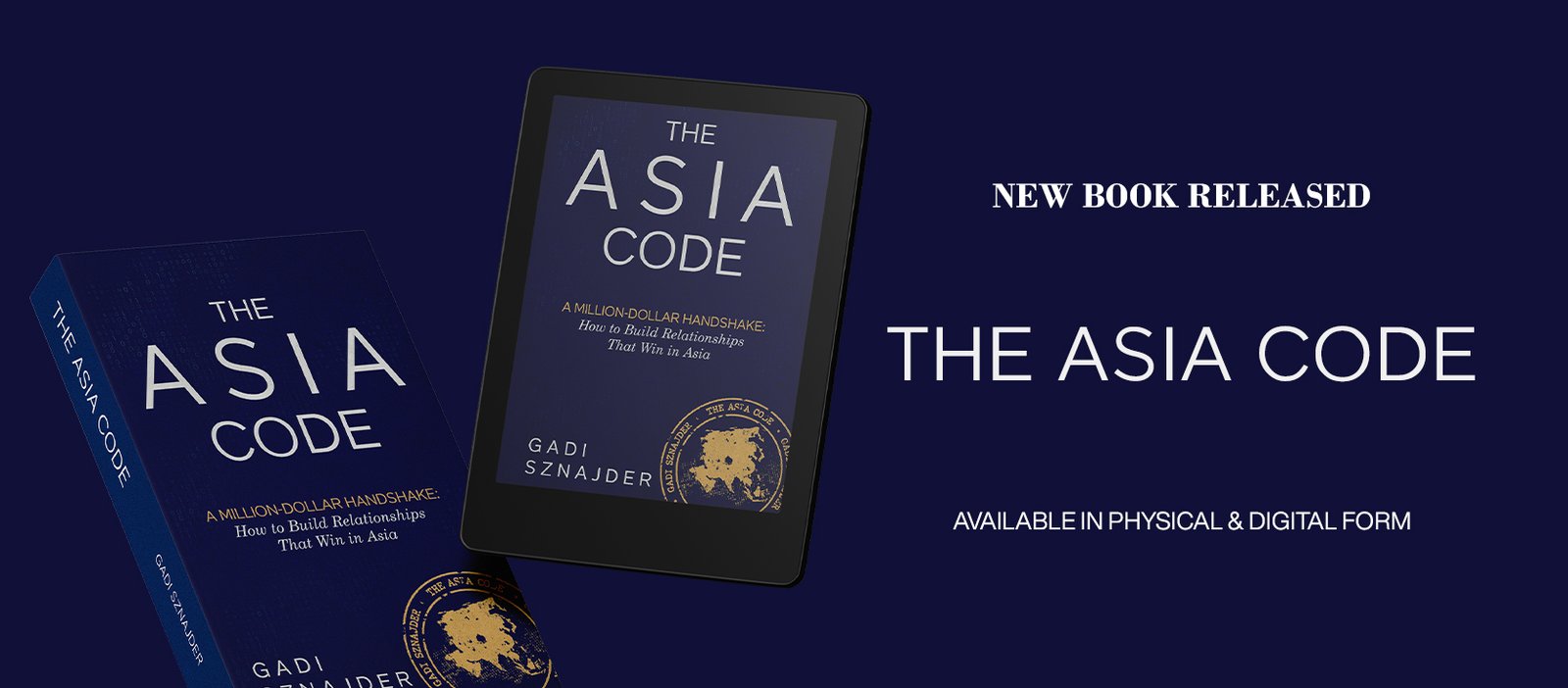
New Book Release

The Asia Code: A Million-Dollar Handshake

How to Build Relationships That Win in Japan, China, and South Korea

Western business is often played like Chess. In Asia, the game is Go. The Asia Code provides the frameworks you need to navigate this cultural shift, turning one-time transactions into lasting partnerships.

Decoding the Invisible Architecture of Power

Success in East Asian markets requires more than basic etiquette or a translated pitch deck. It demands a fundamental shift in how you perceive trust, hierarchy, and negotiation. The Asia Code moves beyond academic theory to offer battle-tested strategies drawn from real negotiations, real partnerships, and real failures.

The book introduces the concept of Relationship Velocity, a framework for accelerating the trust-building process by focusing on character-based trust rather than technical competence alone. It details the Four Pillars essential for success in Asian business: Hierarchy and Harmony, High-Context Communication, Relationship-based Deals, and the Long Game. And it provides country-specific playbooks for Japan, China, and South Korea, the three largest and most complex markets in East Asia.

Whether you are a supply chain manager negotiating with a Japanese manufacturer, a sales leader entering the Chinese market, or a corporate executive building a partnership in Seoul, this book gives you the cultural intelligence to turn a simple handshake into a lasting, profitable relationship.

“In Asia, you aren't just presenting a product; you are proposing a marriage for the next fifty years.”

“Nobody signs because the slides are good. They sign because they believe you will not disappear.”

“The real art of cracking the Asia Code is not about decoding a culture; it is about connecting with a person.”

“In Asia, the deal is never the destination. It is the relationship that carries you there.”

Look Inside The Asia Code

Experience the writing style, real-world case studies, and practical insights that readers describe as genuinely eye-opening. Read this preview to discover why cultural intelligence is the ultimate competitive advantage in Asian business.

Preface / Introduction Preview

Every failed deal has a visible explanation and an invisible one. The visible explanation is easy to write in a report: the price was wrong, the timing was bad, the partner was not ready, the market was too complex.

The invisible explanation is usually quieter. Trust was never built. The hierarchy was misread. Silence was mistaken for agreement. Patience was confused with indecision.

The Asia Code begins with that invisible layer, because it is where many Western companies lose before the negotiation formally begins. In Tokyo, Beijing, and Seoul, the meeting room is rarely the whole game.

A polished presentation may open the door, but credibility, consistency, and character determine whether anyone invites you deeper into the relationship.

Western business often rewards the speed of chess: direct moves, aggressive positioning, and a clear path toward checkmate. East Asian business often resembles Go: patient placement, long memory, encircled influence, and the slow creation of advantage.

The shift is not cosmetic. It changes what counts as progress, what counts as respect, and what counts as proof that you are worth trusting.

This book is the distillation of two decades spent on the front lines of cross-cultural business in Asia. It is not a sterile academic text, but a map to help you navigate the human terrain of business in the region.

It grew out of a desire to share the patterns observed over those years: the unwritten rules, the cultural operating systems, and the frameworks that help bridge the gap between Western and Asian ways of doing business.

Whether you are a supply chain manager negotiating with a Japanese manufacturer, a sales leader entering the Chinese market, or a corporate executive building a partnership in Seoul, the goal is the same: to turn a simple handshake into a lasting, profitable relationship.

That journey begins here.

The Playbook for Asian Business Success

Seven chapters. Three countries. Three proprietary frameworks for lasting success.

Intro

Cracking the Asia Code

A vivid scene in a Tokyo boardroom reveals the gap between Western presentation-driven business and Asian relationship-driven trust. This chapter sets the stage for everything that follows.
2

Fundamentals of Cross-Cultural Communication and Trust-Building

How to read between the lines, decode high-context communication, and build the character-based trust that Asian business partners value above all else. Introduces the book's three proprietary frameworks: BRIDGE, TRUST, and ADAPT.
4

Mastering the Dragon — Guanxi, Face, and the Asia Code in China

Understanding the power of guanxi, the critical importance of mianzi, and the informal leverage that drives Chinese business negotiations.
6

The Invisible Architecture — Mastering What Lies Beneath the Surface

The hidden structures of power, influence, and decision-making that operate beneath the visible surface of every Asian business interaction. This chapter ties together the lessons from all three countries.
1

People Before Protocol — The Four Pillars of Asian Business Culture

The foundational framework: Hierarchy and Social Order, the Art of Indirect Communication, Strategic Patience and Relationship Investment, and Navigating Ambiguity. Understanding these pillars is the prerequisite for success in any East Asian market.
3

Mastering the Unspoken Rules of Japanese Business

Navigating consensus-driven decision-making, the art of silence, the role of ritual, and the patience required to earn trust in the world's most process-oriented business culture.
5

Building Brotherhood — The Art of Korean Business Relationships

Decoding kibun, the intensity of Korean relationship-building, the role of chaebols, and the fast-paced pali-pali culture that demands both speed and deep personal bonds.
7

Living the Asia Code

The practitioner's journey from student to master. How to internalize the frameworks, develop radical empathy, and transform cultural intelligence from a set of rules into a way of life.

Hear from the Author and Readers

Real perspectives on cultural intelligence and the strategies behind The Asia Code.

What Readers Are Saying

Real feedback from readers applying the principles of The Asia Code in real-world business environments.

★★★★★

More Than Just a Business Guide, It's a Human Map

As someone who has navigated professional spaces for years, I've read my fair share of dry how-to business books. The Asia Code is different.

Gadi Sznajder doesn't just give you a checklist of protocols; he teaches you how to actually connect with people. What I loved most is how it simplifies the massive cultural gap between the West and East Asia.

A human moment that really stuck with me was the story of Antoine, a French executive who did everything by the book in South Korea. It's a powerful reminder that in these markets, you aren't just presenting a product; you are proposing a marriage for the next fifty years.

- Verified Amazon Reader
★★★★★

Where Deals Begin with Trust

I picked this up before a work trip to Singapore, expecting a few surface-level tips on business etiquette, but it ended up being far more insightful than that.

The book makes a strong case that relationships, not strategies, are what truly drive success across Asian markets.

What stood out to me was how it breaks down cultural nuance in a way that feels practical rather than academic. The sections on trust-building and reading between the lines in negotiations were especially useful. It challenged a lot of my assumptions about how deals get done.

- Verified Amazon Reader
★★★★★

Great Insight

If you're thinking about doing business in Asia, this book is a really helpful and easy read.

The Asia Code breaks down a simple idea that's easy to overlook: in many Asian markets, relationships matter more than quick deals. The author explains this in a very clear, practical way, without making it feel complicated.

What I liked most is that it's full of real-world advice you can actually use. It explains how to communicate better, why being too direct can hurt you, and how trust is built over time. Main takeaway: don't rush the deal, build the relationship first, and the results will come.

- Verified Amazon Reader
★★★★★

The Asia Code

Most of us think closing bigger deals means being sharper, faster, and more persistent. This book flipped that idea for me.

The Asia Code isn't theory-heavy, it's built on real experiences, and you can feel that. The biggest shift in perspective is how business in many Asian markets revolves around trust first, deal second.

One idea that stuck with me is the comparison between chess and Go. If I had to sum it up: talk less, observe more, and don't rush what's meant to take time.

- Verified Amazon Reader
★★★★★

Street Smart Wisdom Enclosed

What if the secret to closing million-dollar deals across Asia isn't about pushing harder, but knowing when to step back?

In The Asia Code, Gadi Sznajder distills over two decades of real-world deal-making into a guide that's refreshingly practical, not academic.

The big idea? In Asia, relationships eat transactions for breakfast. While Western business often chases speed, data, and the next quarterly win, Sznajder shows that trust, patience, and long-game connection rule in places like China, Japan, and South Korea.

- Verified Amazon Reader
★★★★★

Beyond the Handshake

Gadi Sznajder's The Asia Code provides a fascinating departure from the usual academic primers on international business.

The book's central idea lies in its Four Pillars: Hierarchy and Harmony, High-Context Communication, Relationship-based Deals, and the Long Game.

I highly recommend this for supply chain managers, sales leaders, and corporate executives trying to turn a simple handshake into a lasting profitable partnership.

- Verified Amazon Reader
Gadi Sznajder

About Gadi Sznajder

For over two decades, Gadi Sznajder has operated at the intersection of global business and cultural intelligence, helping companies bridge cultural gaps, build trust, and scale internationally. As the Founder and CEO of GS Consultancy, he works with organizations seeking to expand into new markets with cultural precision, leveraging deep expertise in cross-cultural communication and relationship-driven strategy to transform complexity into strategic clarity.

The Asia Code is the distillation of the lessons learned from facilitating partnerships and market entries across Europe and Asia, the book Gadi wishes he had read before embarking on his own extensive business adventures in the region.

Frequently Asked Questions

What is The Asia Code about?+

The Asia Code by Gadi Sznajder is a practical guide for business professionals working with Japan, China, and South Korea. It explains why Western companies often fail in Asian markets by applying a Chess mindset when their counterparts operate with a Go mindset. The book provides frameworks including the Four Pillars of Asian Business Culture and the concept of Relationship Velocity.

Who should read The Asia Code?+

The Asia Code is written for supply chain managers, sales leaders, corporate executives, and entrepreneurs who are doing business in or planning to enter East Asian markets, specifically Japan, China, and South Korea.

What frameworks are introduced in The Asia Code?+

The book introduces three proprietary frameworks for cross-cultural business: the BRIDGE framework, the TRUST framework, and the ADAPT framework. It also details the Four Pillars of Asian Business Culture.

What is Relationship Velocity?+

Relationship Velocity is a concept introduced in The Asia Code that describes how to accelerate the trust-building process in Asian business cultures by focusing on character-based trust rather than technical competence alone.

The deals you lose in Asia are the ones you never understood.

Join thousands of professionals who are building relationships that win in Japan, China, and South Korea.

The Asia Code available in physical and digital form

Featured Across Major Publications

As Featured In

The Asia Code and Gadi Sznajder’s work on cross-cultural business strategy have been featured by major publications and recognized within the international business community.

Pacific Book Awards

Awards Recognition

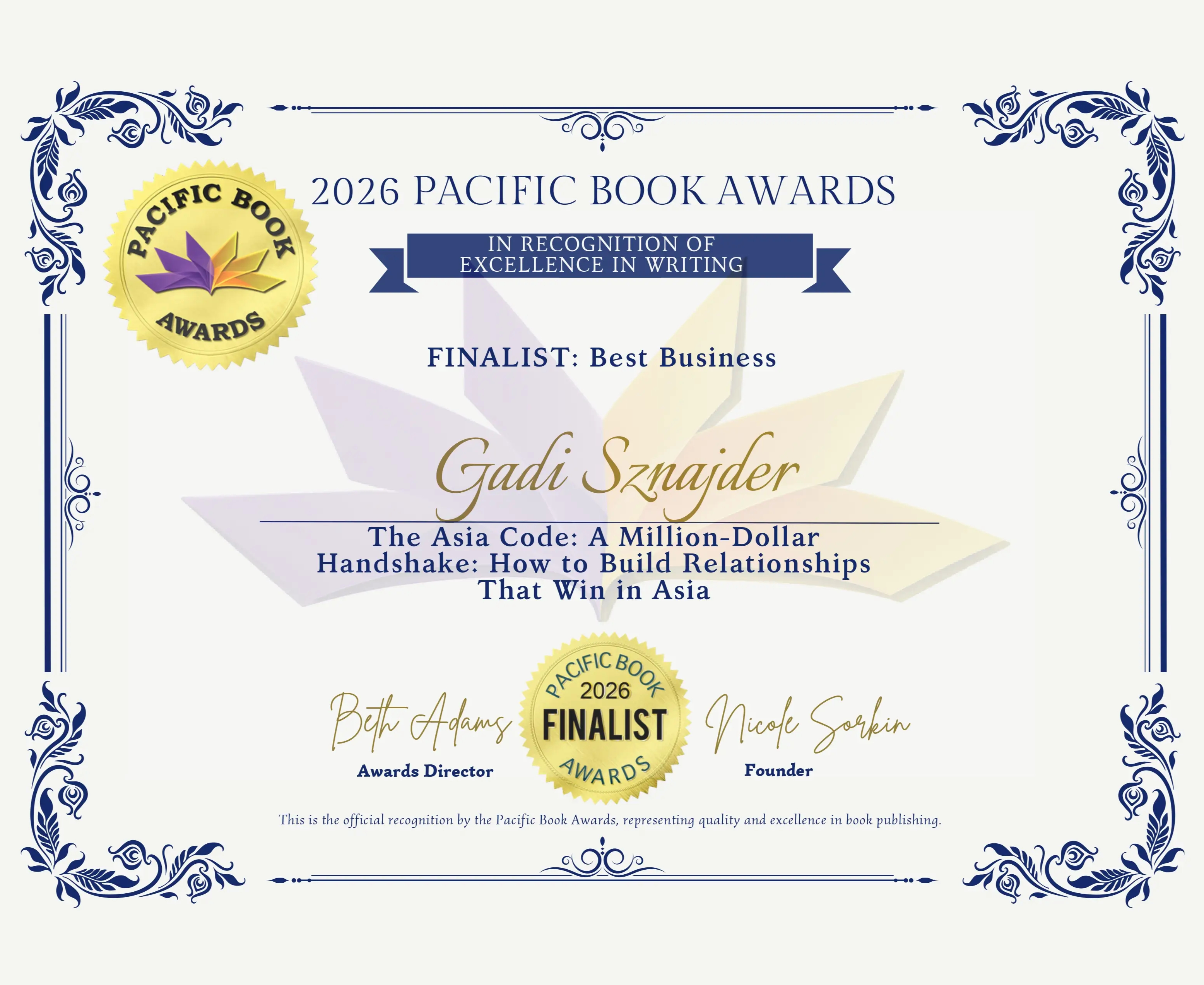
Pacific Book Awards Finalist Best Business Book 2026

Recognized for practical insights into relationship-driven business strategy across Japan, China, and South Korea.

View Awards Recognition
Literary Titan Gold Book Award

Awards Recognition

Literary Titan Gold Book Award Winner 2026

Recognized for excellence in nonfiction and outstanding business insights.

View Award Recognition

Invite Gadi to Speak

Interested in having Gadi speak at your conference, leadership event, executive workshop, or private business gathering? Use the form below to get in touch directly.

For general business inquiries, please visit the GS Consultancy contact page .